
 Subhadeep
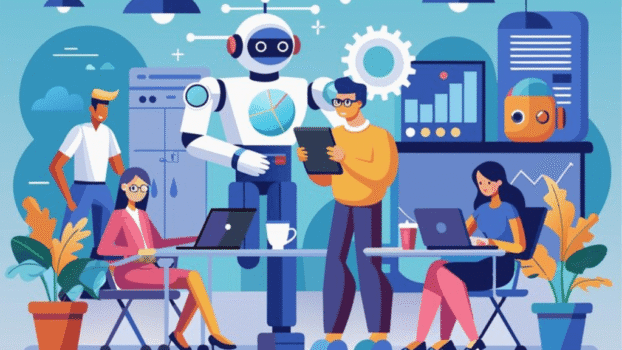
7 Secrets Key Trends in the Future of Robotics – The future of robots is no longer in our imagination; it is taking shape right before our eyes. In hospitals and factories, in cities and homes, robots are a part of our life today. Thanks to Artificial intelligence, Automation, and innovative engineering, robotics is going to see a new revolution that will redefine industries and daily life for all times to come. Companies already employ robots to power efficiency, cut mistakes, and save money, and people already live with intelligent home automation products that simplify life. The transformation is occurring so quickly that yesterday science fiction has become today’s fact.
Here are 7 behind the scenes significant trends that indicate how the future of robotics is transforming our world. These are not human substitution robot trends but trends in developing smart, secure, and green solutions for the globe. From robots’ emotional intelligence to artificial intelligence, from green technology to healthcare technology, the future of robotics is replete with limitless possibilities. Being familiar with these significant trends will enable us to ready ourselves for what is coming our way and reap the most from robotics benefits in our lives.
7 Secrets Key Trends in the Future of Robotics –
AI-Powered Robotics Revolution –
Artificial intelligence is greatly influencing the future of robotics. AI robots no longer perform purely programmatic functions; they can learn, develop, and make decisions by themselves. The revolution is bringing robots to life to become intelligent, efficient, and advantageous to every sector. For instance, in the Medical industry, Artificial intelligence powered robots can read through patient records, aid doctors during operations, and even diagnose illnesses before they spiral out of control. In industry, robots run by Artificial intelligence are boosting productivity as they take over complicated tasks at a speedier and more accurate rate.
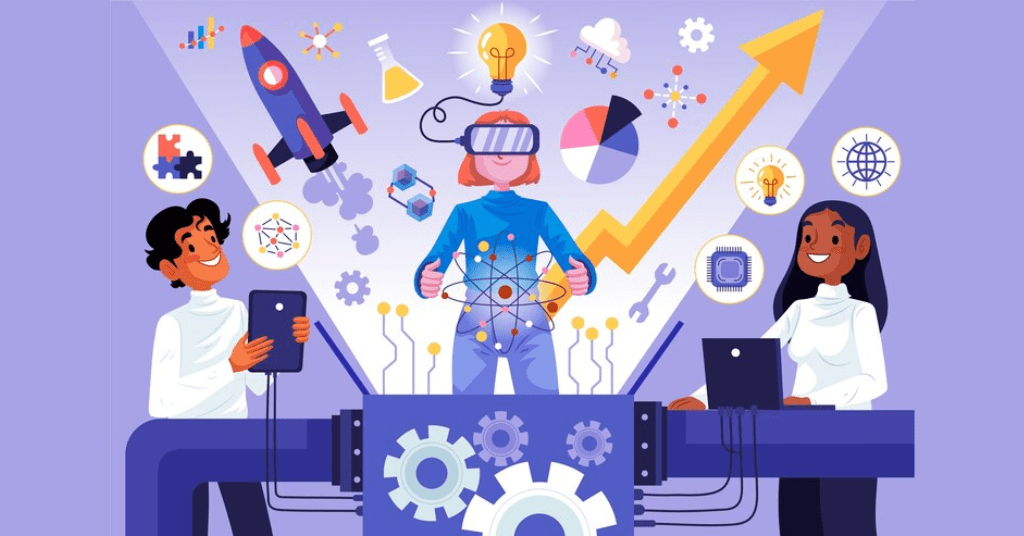
AI-Powered Robotics Revolution
The greatest excitement of robot technology with AI is self-improvement. Robots can learn to improve themselves from what they observe and improve how they carry out tasks. It implies that firms such as logistics, customer service, and retail will have machines that make their intellect improve over time. Robots will also assist people in working as clever assistants in the future, therefore making people good decision-makers and allowing intricate work. Such a revolution also implies that robots can manage unforeseen situations, and therefore they are more dependable in practical use. As AI advances, robots will be able to pursue even more innovation to solve issues, as humans do. The robotics revolution sparked by AI is not solely focused on automation; it is about developing intelligent friends who will change how we work and live tomorrow.
Human-Robot Collaboration (Cobots) –
The best aspect of robots in the future is the development of collaborative robots, or cobots. Unlike other manufacturing robots that operate independently of human beings, cobots are designed to work together with human beings. Cobots are safe, user-friendly, and designed to support the work of human laborers without replacing them. Their main purpose is to increase productivity without risking humans and making them tired.
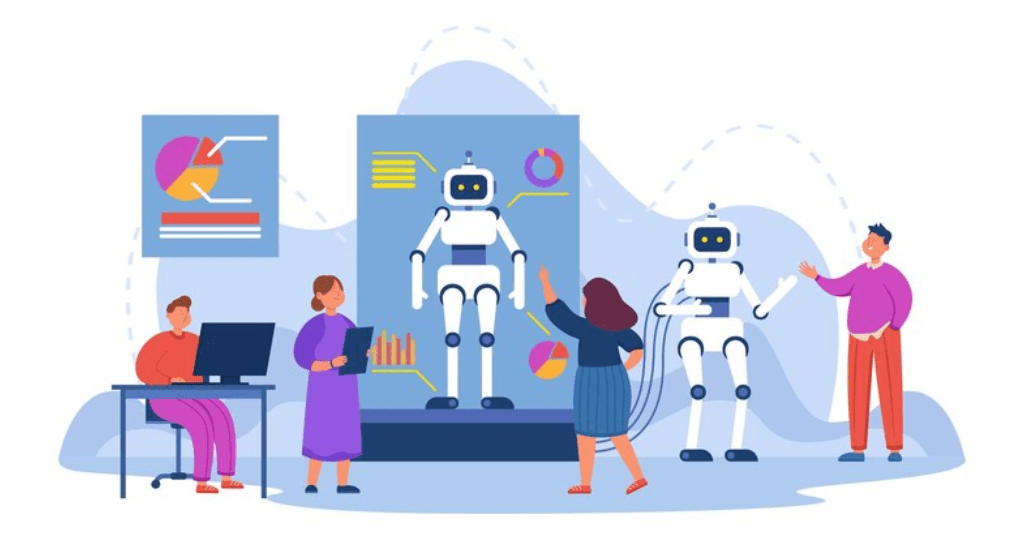
Human-Robot Collaboration
In industries and others, cobots already assist employees with heavy loads, with precise parts assembly, and performing repetitive tasks. They accelerate the process without compromising employees’ safety. With their ease of programming, even small enterprises now start using cobots in an effort to maximize productivity. This establishes them as a pillar of establishment for the future of robotics for companies of all sizes. The second benefit of cobots is that they are economical. Unlike industrial robots, where a massive amount of money and complicated installations are needed, cobots need no massive capital and complicated installations. They are flexible, thus can be integrated into various industries such as agriculture, logistics, and even in medical laboratories. As the technology keeps on evolving, cobots will become smarter and responsive to human needs. The future of robotics will not be man against machine, but man and machine as partners. Cobots are the prime example of work together, and they are showing us that the future of robotics is collaboration, safety, and productivity.
Robotics in Healthcare and Surgery –
The Medical sector is one of the biggest to gain from the future of robotics. Robots are renovating the way doctors diagnose and treat patients, operate, and treat patients. In contemporary hospitals, operating robots are used to carry out very advanced procedures with precision. The technology has the ability to make smaller incisions, recover quicker, and reduce surgical complications, meaning improved results for patients. Beyond the operating room, robots are becoming more involved in rehabilitation and geriatric care. Patients are achieving mobility after an injury due to robots, and robot caregivers are tending to elderly patients with activities such as walking, eating, or even simply companionship. The next step for robotic medicine will likely include remote surgery, where surgeons are able to perform surgery remotely from elsewhere using sophisticated robotic equipment. This would make sophisticated care available even to rural patients.
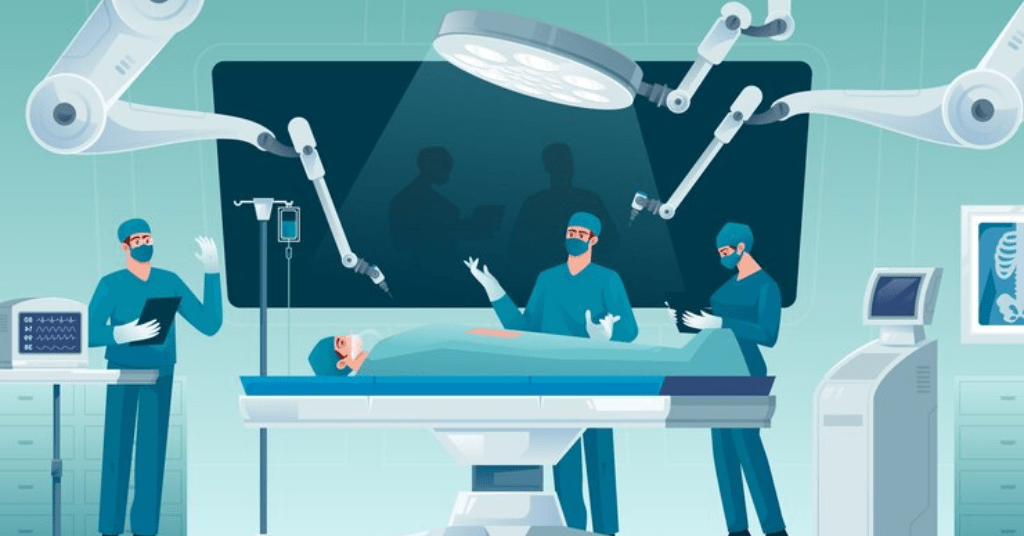
Robotics in Healthcare and Surgery
Artificial intelligence also has its own significant role to play in Medical Robots. Artificial intelligence-based diagnostic robots are able to process data, diagnose illness at the initial stage, and help doctors make proper decisions. Robotic technologies integrated with AI can arguably revolutionize prevention medicine. The future of medicine with the help of robots is not merely a question of saving lives, but one of getting better healthcare that is more accessible, more affordable, and more person-specific. As it continues to improve, medical robotics will become an essential partner to doctors and a valued companion to patients everywhere.
Autonomous Mobile Robots (AMRs) and Drones –
AMRs and drones are transfiguring the robotics manufacturing to simplify mobility and delivery. The robots travel around rooms independently through the use of sensors, cameras, and artificially intelligent mapping technology. In contrast to rigidly programmed robots on fixed routes, AMRs and drones have the ability to adopt novel situations and select the best route to accomplish a task. AMRs are used in warehouse logistics to move commodities safely at a high speed. Amazon uses robots to move commodities efficiently without human involvement and expediting delivery systems. Drones are increasingly being used in supply chains through door-to-door package delivery. The trend will be facilitated once the technology of drones matures and also the policy eases.

Autonomous Mobile Robots
Future AMRs robots and drones also work in business. Drones, used inside cities, are applied to help manage emergencies in the aspect of delivering medical help, discovering disasters, and assisting in rescue. Agricultural drones assist farmers in managing crops and increasing output. When cities are becoming “smart cities,” drones and AMRs will be a fixture in the cityscape to ensure maximum transport and services. The robotics future in this area will be that of efficiency, safety, and accessibility, accelerating life on a day-to-day basis so all can live faster and more easily.
Robotics with Emotional Intelligence –
Most revolutionary among the advancements of next-generation robots is emotionally intelligent robot design. No longer are these robots’ action-performing machinery but robots capable of feeling, reacting, and sympathizing with human emotions. With the incorporation of highly sophisticated sensors and artificial intelligence, emotionally intelligent robots can read facial expressions, tone, and body language to modify their action based on the same. This technology finds application in customer service, therapy, and education fields on its own. As an example, robots can be used to deliver individualized experience in a compassionate and empathetic manner and for specific needs. On the medical front, these emotionally smart robots could help mentally challenged patients by taking care of them and keeping them company. They can teach school students more interactively and enjoyably.
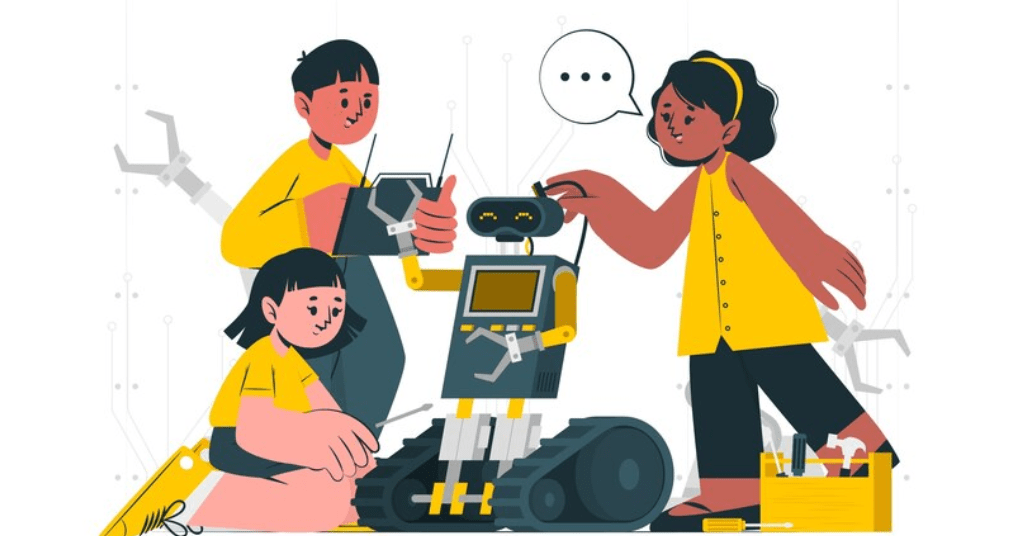
Robotics with Emotional Intelligence
Robots of the future in this field also involve robots as companions to the household members. They will help families by offering companionship to old or young children through learning how to play. Robotics will enable the robots to pretend as if they feel that they are not machines but pleasant companions because of emotional intelligence. While affective robots are not yet upon us, they are a revolutionary new means by which human beings will communicate with machines. The days of debating intelligence and automation for robots are behind us now. The future of robots is making intimate human-robot relationships. That is the wave that will change people’s attitudes and responsiveness to robots in their everyday lives.
Sustainable and Eco-Friendly Robotics –
The future of robotics is also green and more sustainable and environment-friendly. Owing to the prevailing problem of climate change, pollution, and a lack of resources, the future of robotics is being designed with green motives. Green robotics is focused on designing machines that are energy-conserving, wastage-minimizing, and environment-saving. In agriculture, robots are assisting in reducing the application of poisonous chemicals by monitoring the well-being of the soil and using water or fertilizer more efficiently. Robots in depots sort and recycle the waste material faster and with greater accuracy than humans, and the useful resources are being reused again. Robots monitor forests, oceans, and wildlife, and help trace and conserve endangered species.

Sustainable and Eco-Friendly Robotics
Energy efficiency is also a significant aspect of sustainable robotics. Robots are being designed to use less energy, run on alternative energy sources, and produce less carbon output. This is becoming more relevant in industrial robotics, where there are numerous machines that are utilized daily. Future robotics in sustainability will focus on integrating technology and nature. Green robots can support companies in development without destroying the planet. Robotics innovation is a means through which robotics can engineer a better future not only for human beings but also for the world we live in.
Robotics in Everyday Life and Consumer Markets –
The future of robots is not only in hospitals and industries but also in everyday life and consumer markets at a rapid pace. From domestic cleaning robots in the shape of smart vacuum cleaners to AI-based personal assistants, robots are entering the fabric of daily life. They are designed to simplify life, save time, and improve lifestyle standards. It becomes feasible for home robots to be compatible with IoT products these days, so that they become capable of making light, security, and entertainment systems controllable.
For example, robots are capable of reminding people about appointments, helping in cooking, and even maintaining the household tasks. Consumer robotics will further include personal care robots, robot pets, and entertainment companions in the next couple of years.

Robotics in Everyday Life and Consumer Markets
The future robotic homes are all about customization as well. Depending on the deployment of AI integration, the robots have the ability to learn individuals’ own habits and taste, and therefore become more useful and efficient. With technology advances that lower the cost, these technologies would no longer be a luxury for the wealthy but will be part of regular homes in the world. The rapid growth of consumer robotics is proof of the way technology is gradually becoming a part of human existence. Robotics will make homes intelligent, secure, and more convenient in the future, with more time for humans to focus on important aspects of life and machines handling routine tasks.
Challenges and Ethical Considerations –
While the future of robotics is optimistic, so are its immediate problems and ethics. They include job replacement. With more advanced robots, humans worry that they will substitute for human labor, particularly in manufacturing and logistics. To address this challenge, however, comes the need for reskilling and new fields in which humans and robots can work together. Security and data privacy are also big concerns. Most sophisticated robots are founded on the collection and analysis of personal information to perform at their best. In the absence of regulation, there is a high probability of misuse or breach of sensitive data. Therefore, policies should be set firmly for the purposes of security and trust.

Challenges and Ethical Considerations
There is also a question of how much control to vest in robots when it comes to decision-making. Should, for example, robots be deciding life and death issues in health care or war? The questions allude to the necessity of having international standards and regulation of the process of designing robots. Accessibility is a particular issue. The benefits of robots do not always apply to advanced economies and firms but need to be made accessible to the ordinary people and developing nations too. Future of robotics must be attained by a union of responsibility and innovation. All these challenges must be overcome in advance to ensure that the society will be able to reap the benefits of robotics without losing anything. The intent should be application of robotics as a force for good that helps human beings and keeps human values intact.
The Future of Robotics and Artificial Intelligence –
Artificial intelligence and robots’ future is most likely the most thrilling innovation that is transforming today’s world. Together, these 2 technologies are transforming human lifestyles, workplaces, and how humans interact with machines. Robotics has always revolved around creating machines to do things for humans, but when tied together with artificial intelligence, robots are no longer machines. They gain the capability to judge, learn, and improve, evolving from mechanical tasks to mental partnerships with human beings. The destiny of robotics and AI can revolutionize industries, redefine medicine, enhance education, and even improve life at home.
Most significant of all about artificial intelligence and robots in the future is how they affect industries. Artificially intelligent robots can now do more than assemblage tasks. Robots can scan production lines, identify defects, and recommend ways to improve efficiency. Industries are less expensive, safer, and faster. Autonomous robots and autonomous robots employing AI in logistics are already revolutionizing transportation. Commodities delivery, smarter and smarter supply chains. Robotics and artificial intelligence will revolutionize agriculture with intelligent machines to water and fertilize plants, harvest precisely, and reduce wastage and maximize use.
Future of Robotics
Health is one area where the future of artificial intelligence and robotics is transforming lives. AI robots are increasingly being utilized to assist with precise surgery with accuracy beyond human accuracy. Medical diagnostic robots have the ability to learn medical knowledge, diagnose disease at an earlier stage, and treat with accuracy that maximizes patient care. Apart from hospitals, AI-based assistive robots are helping disabled and aged people to live independently by performing day-to-day tasks. Robotics and health care save lives and low-cost and accessible health care to all human beings. In our day-to-day lives, robotics and artificial intelligence will penetrate our domestic lives. Intelligent robots in our homes today already sweep floors, regulate household appliances, and act as virtual assistants. With artificial intelligence, the robots will be increasingly personalized to recognize the likes and lifestyles of the family and adjust to their needs. Emotional robots will also be part of families, sitting alongside them, teaching children, and taking care of elderly parents. This human-to-human interface manner of speaking will dramatically change the way humans think about technology since robots will be seen as companions rather than machines.
Education will also bear the impact of the future of artificial intelligence and robotics. Intelligent robots will assist educators in providing students with customized learning experiences. The robots will be able to customize lessons according to the unique learning pace and style of every child, making learning easier to use and effective. AI learning robots can also bring learners from all parts of the world together, despite language or culture, with room for globalization. Class room robots will not displace teachers but equip them with additional tools with which to inspire and challenge kids in alternative manners.

Artificial Intelligence
The robotics and artificial intelligence future also equates to new possibilities for public services and smart cities. Artificial intelligence traffic and driverless cars will provide easy and safe travel. Robots and drones will aid emergency services, from delivering medical supplies to helping in the wake of a disaster. Smart robots will render the population safer by providing the ability to monitor environments and respond to danger in real time. All these technologies will organize cities more efficiently, render them sustainable, and livable for centuries. While it is evident that the benefits of the future of robotics and artificial intelligence are clear, there are also stakes involved with far-reaching implications.
One of them is the belief that human workers would be replaced by robots. There would be automation of repetitive work, but new opportunities would arise in robot designing, programming software for AI, and systems maintenance. The second issue is security and privacy since a lot of AI robot technology relies on data capture of individuals’ personal information to enable them to work effectively. More stringent policies and codes of ethics will be required to regulate the use of these technologies for the proper reasons. Robotics and artificial intelligence in the future must combine innovation and safety and justice so that the people would have faith in them. And although in the future, robotics and artificial intelligence are not human vs. machine competition but one working in tandem.
Artificial Intelligence-2
Artificial intelligence and robots will be best buddies, doing the grunt that is risky, boring, or brain-dulling so people can think about creativity, judgment, and emotional intelligence. Robotics and AI will change all the nooks and crannies of society in the next few years, from the corporate and healthcare worlds to the classroom and living room. This convergence has the ability to make the world smarter, more productive, and more connected. For the most part, the future of robotics and artificial intelligence is endless to the extent that it can redefine how the world is run. With the combination of robotics strength and the creativity of AI, we are progressing toward an age when technology will be human capability. It is a change that will bring in possibilities of growth, innovation, and an uncomplex life. With a balanced wisdom of responsibility and creativity, the age of robotics and AI will not only revolutionize business but also enhance the human experience for centuries to come.
Conclusion –
Robotics has an enormous future to transform industries, healthcare, schools, and daily life. From intelligent machines enabled by artificial intelligence to emotionally intelligent friends, robots will be a part of mainstream culture. The seven not-so-secret key trends AI robotics, cobots, medical robots, autonomous mobile robots, emotional intelligence, green robotics, and consumer robotics signal how wide the radius will be. Where as ethics, employment security, and privacy issues need to be tackled, benefits of robotics cannot be ignored. The future does not involve substituting humans but improving human life, industries, and creating smarter solutions for the world’s largest challenges. Embracing these trends and with preparedness for tomorrow’s transformation, we can make robotics a powerful partner in creating a safer, healthier, and sustainable tomorrow. The future of robotics is more than a technology revolution; it is an adventure that will shape the way we live, work, and engage with the world we inhabit.
Read Also Another Article –
5 Great Innovations Shaping the Future of Robotics Strategy
Frequently Asked Questions –
Q. 1. What is the future of robotics in everyday life?
Ans – Robotics in the future of everyday life will directly be associated with the way human beings live, work, and interact with the environment. Home robots are already being placed in homes to perform tasks such as cleaning, cooking, and controlling house appliances, and this will soon be followed by more complicated tasks. Personal robots will be able to schedule tasks, manage IoT appliances, and remind individuals of what they need to do every day, like taking medicine or scheduled appointments. Robotics in the future will also involve robots at home that are able to understand the emotions of human beings and offer companionship for children or the elderly. Far from homes, there will be robots in public spaces with service robots helping restaurants, airports, and hotels to make life simpler. Consumer robotics will not only save time and energy but will also provide comfort and security to families. With added artificial intelligence, the robots will be personalized, considering individualized habits and tendencies of everyone. With technology decreasing in cost, robots in daily life will no longer be a luxury and a tool of necessity, but a smarter and more efficient life for all.
Q. 2. Will robots replace humans in jobs?
Ans – The robotics of the future has with it a very significant consideration regarding employment, and while robots will indeed replace people in some sectors, overall, it will be a function of job change and not job loss in its entirety. Robots are well suited to repetition, risky, or physically demanding work, and as such manufacturing, construction, and logistics will have some robots performing tasks. But the future of robotics is not about taking the human out of the picture but about altering the type of work human beings do. While robots perform routine tasks, humans will have the opportunity to concentrate on tasks that need creativity, strategy, and problem-solving that cannot be emulated by machines. Meanwhile, new areas of employment in robotics programming, maintenance, and systems management will be created with new career opportunities that previously did not exist. History has shown that each technological revolution generates changes in the labor force but also new industries. The future of robotics will be the same where human-robot interaction will increase efficiency in production while new areas of expansion will be available. Rather than being apprehensive about the loss of jobs, societies must invest in training and skill development so that workers can learn to do new jobs as well as take best advantage of opportunities opening with robotics.
Q. 3. How safe are collaborative robots?
Ans – Cobots, or cooperative robots, are built with safety being their priority number one, making them perhaps the most reliable innovation in the future of robotics. Unlike stand alone industrial robots, cobots have sophisticated sensors, visual systems, and pre-programmed safety stops to avoid accidents. Cobots can perceive people, stopping instantly if they bump into anything, and adapting their force to avoid causing damage. The future of robots in the age of cobots is all about humans working in tandem with them, supporting them rather than substituting them, and turning them into effective and safe workers in the workplace. Cobots reduce the threat to workers having to lift or repeat heavy work manually, and improve productivity and workplace safety if applied to manufacturing and logistics. Safety requirements for functioning also adhere to stringent global safety regulations, thus making them safe to function without harming anybody. As better and more advanced AI emerges in the future, cobots will increasingly have the ability to interpret human body language and adapt their outputs accordingly in real-time, further eliminating friction in collaboration. The future of robotics hinges on trust, and cobots are a starting point toward safe human-machine collaboration. It not only makes robots safe to work with together but reliable equipment that small business and large can afford to use.
Q. 4. What industries will benefit most from robotics?
Ans – Robots will impact nearly every field in the future, but some industries will be impacted more due to the nature of their work. Healthcare is one of the biggies where patient care is being revolutionized with automation through robot aid while conducting complex surgeries, diagnostic robots assisting in early detection, and assistive robots assisting disabled and elderly individuals. Manufacturing itself is being transformed with a fundamental shift with automation and robotics making production lines smoother, error-free, and with improved output. Logistics and supply chain also change with products being delivered through drones and self-driving mobile robots, sorting stock, and speeding up delivery. Even farming is embracing robotics to scan and monitor plant health, automate water distribution, and harvest crops automatically, which will be necessary in a bid to service an increasing global population. Services sector also see robots at restaurants, hotels, and airports as they enhance customer experience and reduce waiting time. Even lifestyle and education sectors will be affected in a good way because empathetic robots and prudent assistants provide home administration and education services by using interactive games. The future robots will not be limited to one industry but will bring about healthcare, manufacturing, logistics, agriculture, services, and consumer markets innovations and thus one of the strongest drivers transforming industries today.
Q. 5. How does AI influence the future of robotics?
Ans – The most powerful push factor for robotics in the future is artificial intelligence as it allows robots to learn, adapt to new information, and make choices. Robots could only do programmed work in the past, but today they can process information, understand the world, and become smarter with age after they have integrated artificial intelligence. Robots with artificial intelligence can recognize objects, understand human speech, even predict outcomes, and are much more intelligent than other machines. In medicine, AI enables robots to interpret medical scans, assist doctors in diagnosing, and conduct precision surgery. In manufacturing and logistics industries, AI enables robots to streamline production lines, identify flaws, and remain at optimum efficiency without constant oversight. AI robots will also have emotional intelligence that will make the robots responsive to human emotions and empathetic towards humans, transforming education, therapy, and customer care. Autonomous vehicles, drones, and humanoid robots that collaborate to support human beings all rely on AI to enable them to drive safely and make choices in unfamiliar situations. AI not only makes robots intelligent but also positions their role from being tools to collaborators. The future of robotics and artificial intelligence is a paradigm of robots as solution-based problem-solvers, creative collaborators, and loyal companions to human life.
Q. 6. How will the future of robotics change the way we live at home?
Ans – Future robots will turn homes into smarter, safer, and more efficient homes. Smart robots will work around the home such as cleaning, cooking, and washing, leaving individuals with more time to work and raise a family. Robotic smart intelligent home appliances will also turn a home into a safe house, energy-efficient, and turn settings such as lights and heat to their preference. In the future of robotics, personal assistants based on AI will be reminding individuals what they must do, assist them with scheduling, and even offering companionship to elderly family members. Emotional robots can even be integrated into home life, providing social interface and assurance. This is just making daily life simpler, healthier, and happier, and demonstrating how the future of robotics is going to make human life possible in a supporting and beneficial way.
Q. 7. What role will the future of robotics play in education?
Ans – Bots can play an important part in future education by potentially bettering learning through the potential for conversation, flexibility, and availability. Bots can act as a tool to break down challenging material into play time for kids through bodily contact and immediate manipulation guarantee. They can create instruction to suit the learning pace and passion of each student, offering a one-on-one learning experience that cannot be offered in regular classes. Tomorrow in robotics, emotionally intelligent robots will also offer counsel, guidance, and tailor-made exercise to special-needs children. Outside of the class, education robots will reach learners all over the globe with virtual learning and language support, bridging the gap and distance. The future of the robots within the schools is not to become teachers but to provide teachers with superior means to teach with and to further open children’s minds, leading to an intelligent society better equipped for tomorrow.